
Outdoor Power Cabinet Cooling at 55°C: How to Write Derating into the RFQ & SAT (So Handover Doesn’t Turn into Repeat Service Visits)
In hot-climate outdoor power projects, “cooling capacity” is not a single fixed number.
That’s why many “high temperature alarms” after handover are not because the unit is “bad”, but because derating boundaries were never written clearly into the RFQ:
What is the real ambient the condenser sees?
What installation clearances were assumed?
Does performance need to hold at 55°C?
How will SAT be tested — at night or at the hottest hour?
If these are vague, selection becomes a guess, and handover becomes a debate.
Below is a practical way to write derating into your purchase specification for outdoor power cabinets.
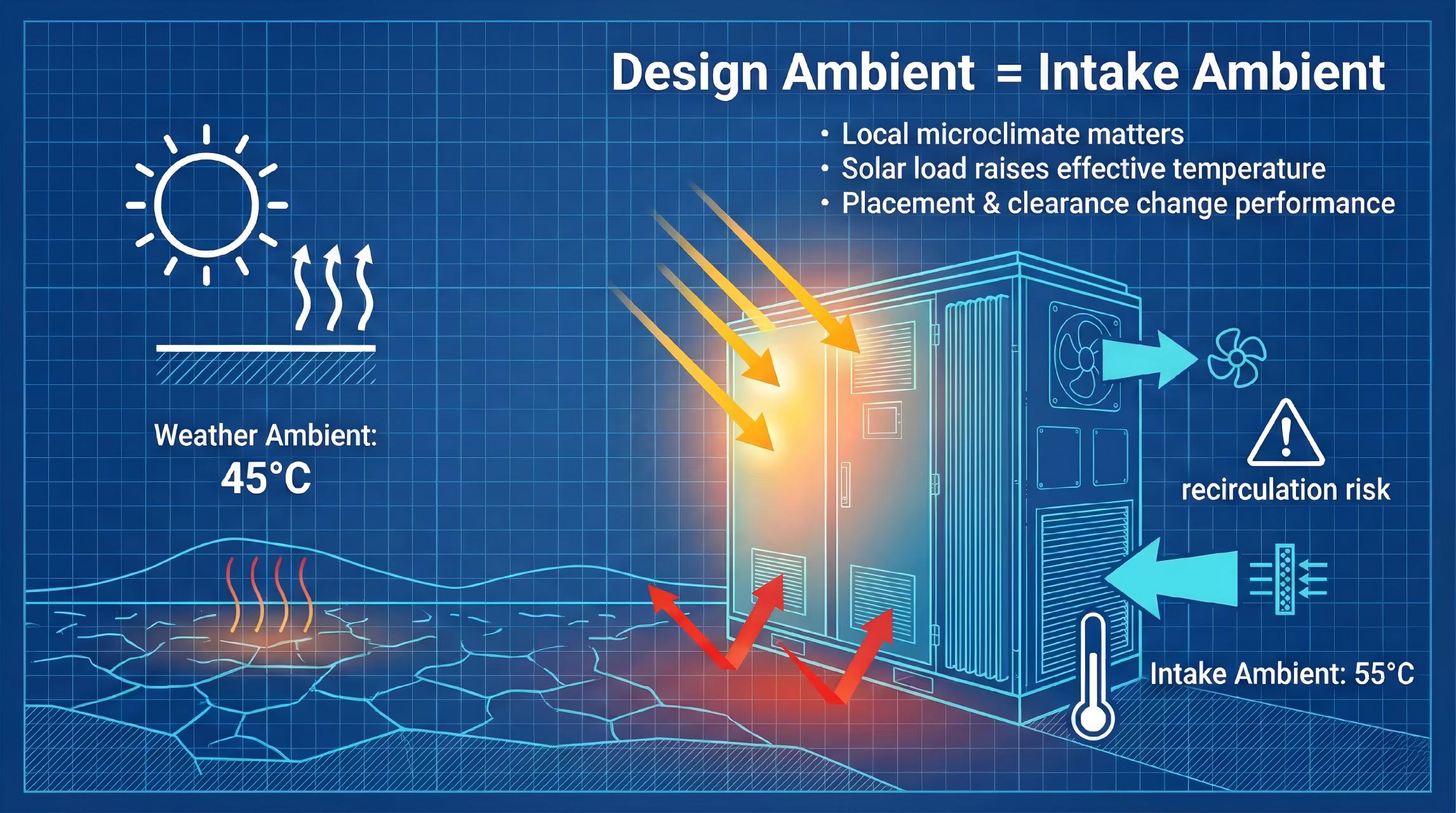
The cabinet AC does not live in the weather report.
Copy-paste RFQ wording
Cooling performance shall be guaranteed at ambient temperature measured at the condenser air intake at the cabinet installation location.
Add the measurement method (prevents arguments later)
Intake ambient shall be measured at the condenser air intake, shielded from direct solar radiation, using a 1–3 minute average during the worst-case hour.
Derating is not only temperature. It is the full set of real-world conditions.
Include at least:
High ambient range (e.g., up to 50–55°C)
Solar condition: shaded vs direct sun (must be explicitly stated)
Clearance & airflow path: minimum distances around intake/outlet (avoid recirculation)
Dust / fouling assumption: clean coil vs realistic accumulation + expected maintenance interval
Power quality: allowable voltage range, frequency, and protection behavior
Copy-paste RFQ wording
Rated capacity applies only when installation clearances, airflow path, and maintenance assumptions are met.
A single rating point at 35°C is not useful for hot-climate outdoor cabinets.
Minimum data requirement
Supplier shall provide a capacity & power table from 35°C to 55°C ambient, including input power and current.
Optional (very useful in dusty sites):
performance impact under partial airflow restriction / fouling condition
recommended cleaning interval assumptions used in performance data
Important note (so nobody nitpicks percentages)
Any derating percentages shown in this document are illustrative only; selection must be based on supplier-provided performance data at the specified intake ambient.
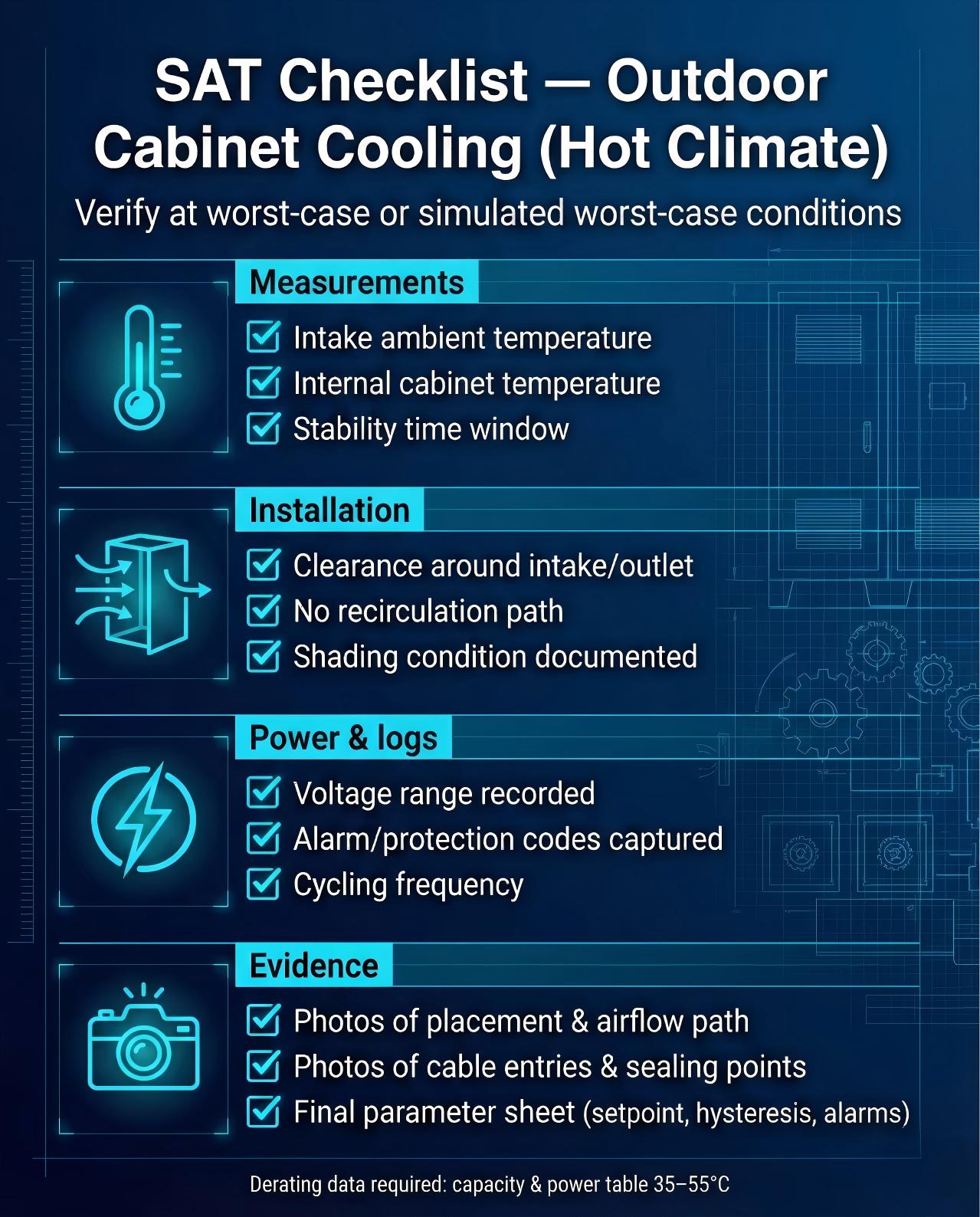
Night SAT validates basic function.
Copy-paste SAT requirement
SAT shall be performed at representative worst-case or simulated worst-case conditions. Record:
Add a pass criterion (makes SAT executable)
Pass criteria: At intake ambient T = ___°C, internal temperature shall be maintained at setpoint ± ___°C for ___ hours with no abnormal cycling or protection trips.
Scenario (outdoor power cabinet):
Estimated internal heat load: 1200W (VFDs, power supplies, comms, etc.)
Desired engineering margin: 20%
Required effective cooling at design condition: 1440W
Now the trap:
Weather ambient might read 45°C
But intake ambient at noon can be 52–55°C at the cabinet location
If a unit’s capacity at 55°C derates to (example) 70% of nominal rating, then:
So selection should not be based on “2000W @ 35°C” marketing rating.
Again: the 70% is only an example — actual derating must come from supplier data.
This prevents “installation problem becomes vendor blame”.
Copy-paste boundary wording
Performance guarantee is void if condenser airflow is short-circuited (recirculation) or if minimum clearances are not met, or if the stated solar/maintenance assumptions are not followed.
Also, explicitly state solar assumptions:
Solar condition (shaded/direct sun) must be stated in the RFQ; direct sun requires additional thermal load consideration (e.g., sunshield/placement).
Application: Outdoor power cabinet (hot climate)
Derating is not extra paperwork.
Quick question (for EPC / O&M teams):
The same cabinet AC that looks perfect on paper can behave very differently once installed at 50–55°C, with solar exposure, limited clearance, and real dust conditions.
1) Define “design ambient” correctly: intake ambient, not weather ambient
It lives at the condenser air intake — often hotter due to solar load, hot ground reflection, nearby heat sources, or constrained airflow.
2) Lock the boundary conditions (this is where disputes start)
3) Request a derating table/curve (not a single “rated W”)
4) Make SAT realistic: “night SAT” is not a handover test
Worst-case SAT validates reliability under real thermal stress and helps prevent post-handover alarms.
(1) condenser intake ambient (shielded measurement, 1–3 min average),
(2) internal cabinet temperature,
(3) installation clearance & airflow path photos,
(4) duty cycle and any protection / fault codes.
5) A simple numeric example (useful in RFQ discussions)
Required nominal rating ≈ 1440 / 0.70 ≈ 2050W
Selection should be based on the supplier’s 35–55°C derating table.
6) Responsibility boundary: define what voids the guarantee
Copy-paste “one-page RFQ spec block”
Design ambient (intake): ___ °C (peak at cabinet location)
Solar: shaded / direct sun (define)
Clearance: minimum ___ mm around condenser intake & outlet
Dust/maintenance assumption: inspection/cleaning every ___ months
Derating data required: capacity & power table from 35–55°C
Power quality: ___ V ± ___%, ___ Hz, protection behavior defined
SAT: worst-case or simulated worst-case; record intake ambient + internal temp + photos
Pass criteria: setpoint ± ___°C for ___ hours @ intake ambient ___°C
Responsibility boundary: guarantee valid only under stated installation & maintenance conditions (no recirculation)
Closing thought
It’s how you prevent repeat alarms, repeat service visits, and handover disputes in hot-climate outdoor power projects.
When you see repeat high-temp alarms after handover, what’s usually missing?
A) derating data at 50–55°C
B) installation boundary (clearance / recirculation)
C) maintenance assumptions (dust reality)
D) SAT method (night vs day)
 http://www.linkedin.com/in/珩-刘-24a90b395